
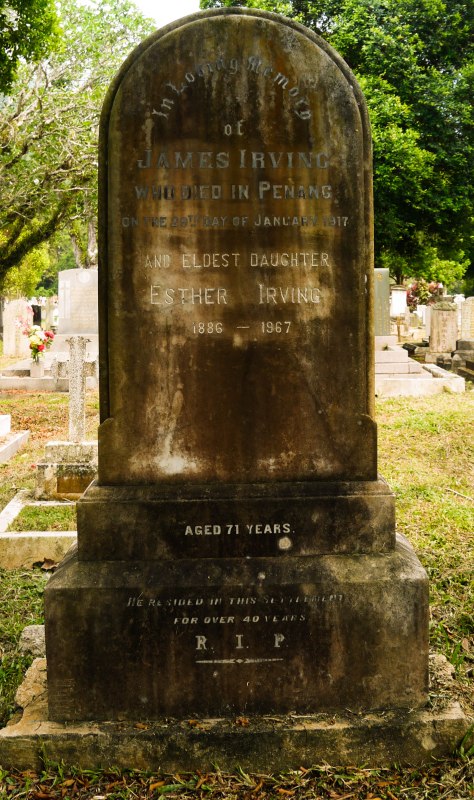
Let’s start this story by clearing up some confusion about names, is it Irvine or Irving? Well it’s both, James Irving of Penang was born & married as James Irvine, but sometime on his journey to Penang from his native Scotland he started using Irving, why the change you are asking ? I have been told by a Irvine cousin, the family story is “He changed to Irving in India as a superior in the Civil Service was a James Irvine.”
James’ father, John Irvine was born on March 16, 1805, in Forfar, Scotland, his father was John and his mother was Christina (possibly from Orkney? but no proof yet). He had six sons and three daughters with Agnes Armstrong (from Ireland) He worked as a blacksmith all his life as per the census’. He died on December 9, 1875, in Old Kilpatrick, Scotland, at the age of 70.
John’s 2nd son, James Irvine was born in 1846 Renfrew, Renfrewshire, Scotland. On 10th May 1870 James married Jessie Denoon Ross (Jessie was born in 1848 in Beauly, Scotland, child of Donald and Helen) in Old Kilpatrick, Scotland. At the time of their marriage James worked as a “moulder’s apprentice” and Jessie was a working at Greenlaw House, Abbey Parish, Paisley, domestic servant.
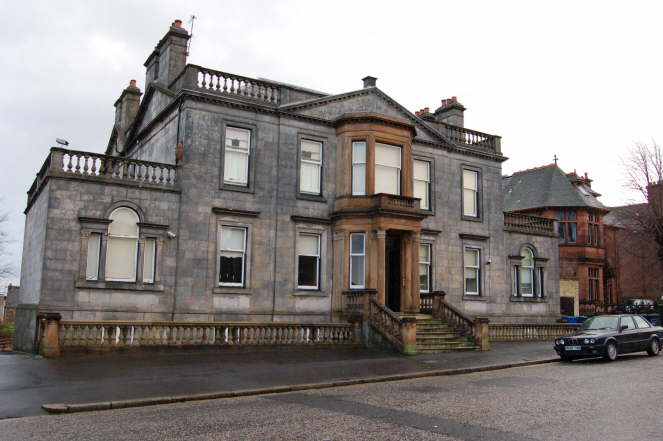
As per the 1871 census Jessie is living at 3 New Land, Old Kilpatrick, Dumbartonshire, Scotland, and states she is an “Engineer’s wife”, James is not listed but Sophie Ross (dressmaker) Jessie’s sister is listed as living with Jessie. Where has James gone, the first recorded occurrence of him in Malaya is in 1877, was he in India working in the Civil Service, as suggested by the change of name (need a trip to British Library!).
Jessie gave birth to their first son, John Irvine, 15 Apr 1872 born in Old Kilpatrick, Dunbarton, Scotland, so James must have journeyed back and forth, cannot find any shipping records so far….
James and Jessie had a further 3 children born in Penang, Straits Settlement (and 2 babies who did not survive);
Alice Kate Irving b. 1877, Evelyne Ross Irving b. 1883, Frederick Ronald Irving b 1884
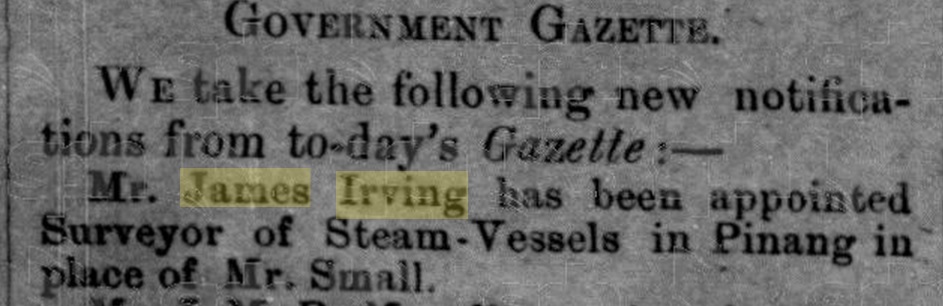
James Irving (new name) is recorded in the Straits Times Overland Journal on 18th May 1887, “has been appointed Surveyor of Steam Vessels in Pinang”
But by the 1891 England census Jessie and her 4 children and sister Sophie are living at 5 Arthur Street, Barton St Mary, Gloucester, England. The Irvine family story goes that Jessie and the children returned to the UK where eldest son John, known as “Jack” could take up an apprenticeship to an engineering firm in Gloucester and Jessie and the family settled there.
Meanwhile back in Malaysia, James is making his way in Penang and he “marries” Chic (Tok mama) and they had three daughters together;
Esther Irving b. 19 Aug 1886
Rachel Irving b.17 Apr 1888
Annie Irving b. 22 Feb 1890
I like to read around the stories I discover about people’s lives and have recently read a facilitating book “Out in the Midday Sun (The British in Malaya 1880 1960)” by Margret Sheenan, I will add a post about some of the books I have enjoyed at some stage…….
To my surprise I found a quote about James Irvine (…ing) which was quite exciting ! Interesting name spelling, perhaps they did not worry so much about spelling their names in those days ?
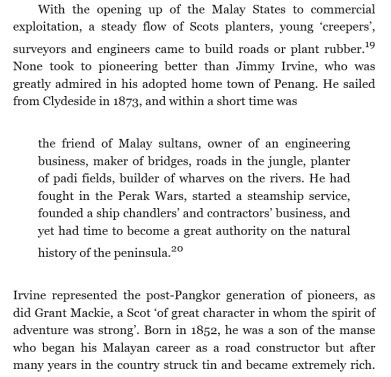
The writer quotes from another book, Home is the Sailor by William Blain (the sea life of William Brown, master mariner and Penang pilot), so a trip to British Library needed, more research required!
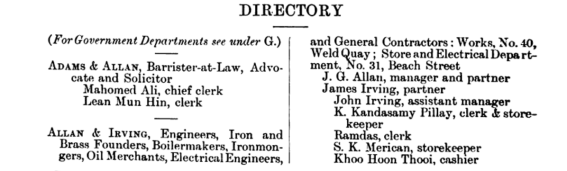
I have recently become a member of the Society of Genealogists and whilst wandering around the library in the small Asian Section I came across a directory , The Directory and Chronicle for China, Japan, Corea, Indo-China, Straits Settlements, Malay States, Siam, Netherlands India, Borneo, the Philippines, and etc a little like the Old UK Kelly’s Directory of trades or a modern Yellow Pages. There was one volume in the library but met a lovely helpful lady who explained that there were other volumes on-line, the image below is from the 1905 volume. The most interesting fact I found was not that James Irving had a business partner, J G Allan in Allan & Irving, Engineers, Iron and Brass, Founders, Boilermakers, Ironmongers, Oil Merchants, Electrical Engineers, and General contractors. BUT working with them as assistant manager in 1905, John Irving, James’ eldest son with his first wife. Jessie and her 4 children, including John, had returned to the UK so that John could take up an Engineering post in Gloucester, so had he come back to Penang to work in his father’s firm, bit of a coincidence if not? John then disappears from directory in 1908 and in the the 1917 directory Allan is in business on his own (not all years available to read on line).
James had an interesting life in Penang and probably had many adventures but only a few tales remain. He purchased land on Cantonment Road and built a substantial house (sadly no pictures seem to have survived), which became the family home for many years, until it was finally sold off, proceeds and some of the land were used to build new homes for the family. Some of the stories of his life are told in his obituaries:
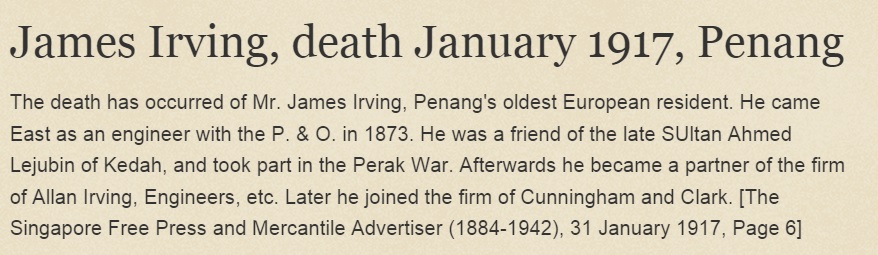
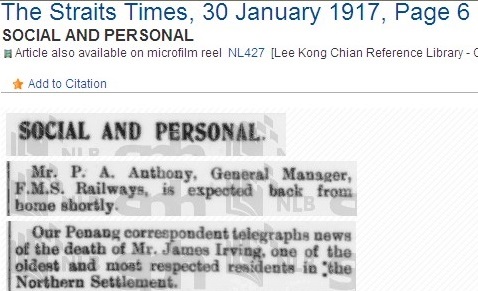
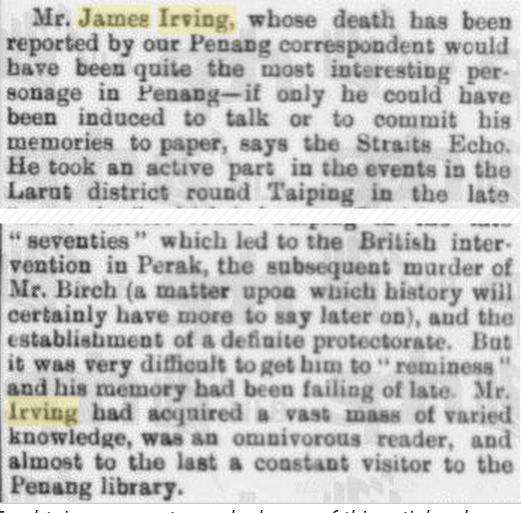

THE LATE MR JAMES IRVING (I understand the article was copied from “The Straits Times” but it is sadly undated and no author is given).
Our London correspondent writes:-
Three weeks issues of your journal have come within three days of each other, and there has not been time to digest all their contents. But I observed with sincere regret the death of Mr James Irving whom I knew well for many years and in whom there has passed away an excellent type of Colonist of who his native country has given so many examples. He was a man possessing great gifts, well read, with a retentive memory, and a Malay scholar with a unique knowledge of the country through which he had travelled so often. In earlier days his position in Kedah was one of extraordinary influence, but he was devoid of ambition and content to go his own way. You have referred to several points in his versatile career, but there are others well worth recording.
He made two or three fortunes and lost them again, bearing ups and downs with perfect equanimity. I remember his pointing out to me what had once been a tin mine owned by himself, and which, after sinking huge sums of money in it he eventually sold for two dollars. He was a perfect master of the lost art of conversation, an admirable story teller, and an evening spent in his company was an education.
The story of his life and adventures would make a fascinating volume. Throughout his career his character remained simple and entirely unspoiled. Never unduly elated by success he was equally unaffected by misfortune and pursued the tenor of his very uneven way with true philosophy. In business matters he was keen and some called him hard, but he was a just man and a generous and un-ostentatious in his charity. He possessed a happy gift of humour which must have been a great comfort. No man I ever knew was more determined in his opinions or more difficult to move after once having made up his mind on any particular point nor do I remember him acknowledging that in any action he had taken he had been in the wrong. But he was absolutely reliable and trustworthy, never knowingly did an injustice and his word was his bond. He was steadfast and also unmovable, a great-hearted man of a type all too rare and the settlement is poorer through his death.
For more information about the Perak War and the death of Mr Birch see http://www.sabrizain.org/malaya/perak.htm
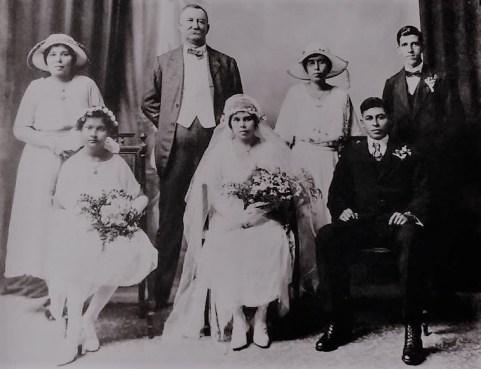
Of James’ 3 daughters only one, Annie, married, Thomas Yean de Bruyne on 20 Mar 1923 and they raised their family in Annie’s family home, 13 Cantonment Road, Penang.
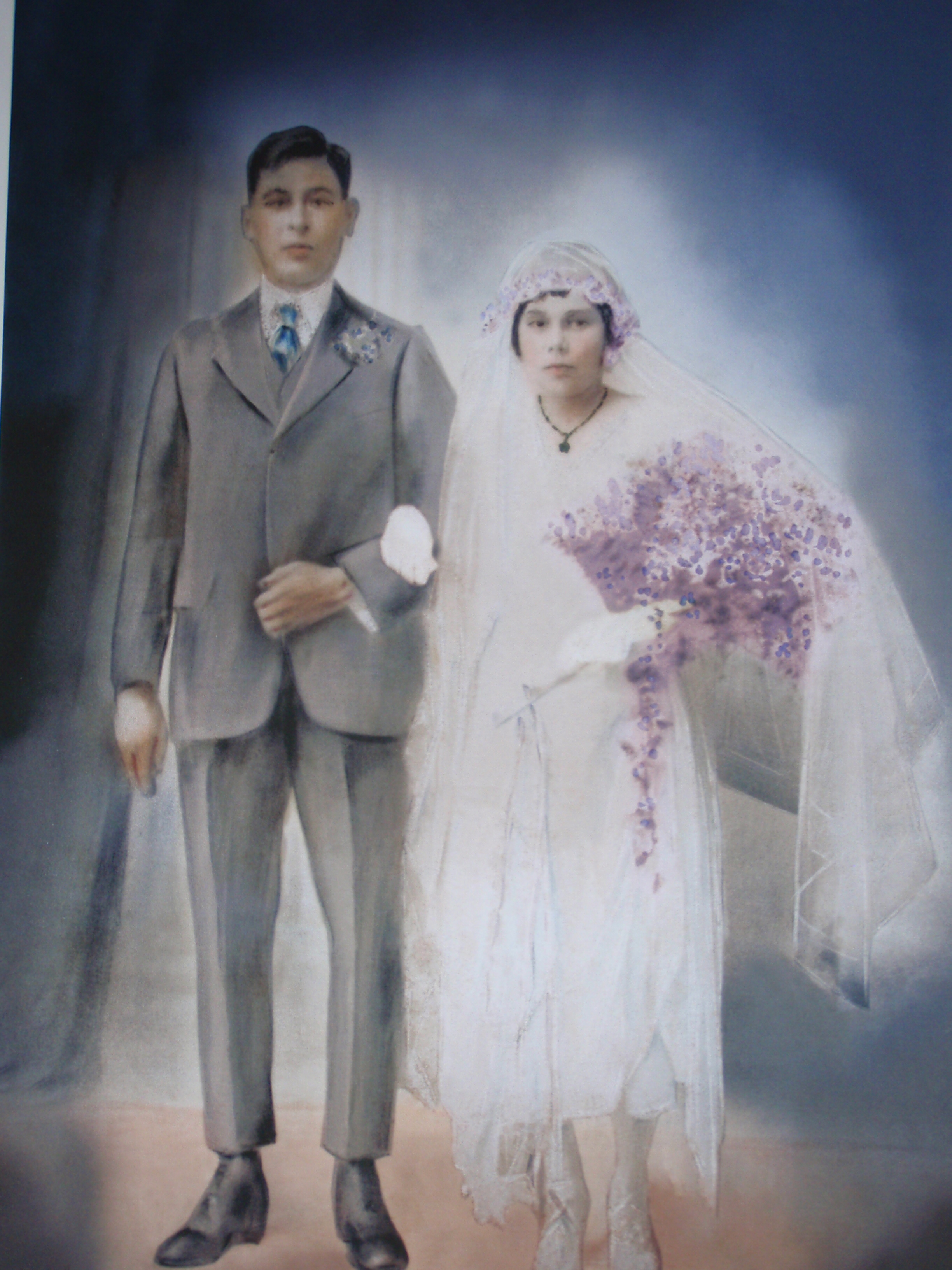
Last August, my husband went to Malaysia and met up with one of his de Bruyne cousins. She had an album of family photos which included one of Annie Irving and Thomas Yean’s wedding.
In August I spent an interesting day at the British Library following up on some literature references I had found.
This is the original text from the book “Home is the Sailor by William Blain (the sea life of William Brown, master mariner and Penang pilot)” and tells the sad story about James’ funeral & the Jack Allan connection…
I watched the burial of Jimmy Irvine and felt that an era had passed. Jimmy had come East, a Clydeside engineer, in 1873, and within a few years was the friend of Malay sultans, owner of an engineering business, maker of bridges and roads in the jungles, planter of paddy fields, builder of wharves on the rivers. He fought in the Perak war, started a steamship service, founded a ship chandlers’ and contractors’ business, and yet had time to become a great authority on the natural history of the peninsula.
The house shared by Irvine and his partner in the contracting, Jack Allan, was the centre of European life when I first came to Penang. These two, Irvine and Allen had a bond of friendship, such as I have never seen before or since. No questions were asked in that house about the others’ comings and goings, no explanations offered.
Their friendship was one of the great natural phenomena of the island, as proudly pointed out to strangers, as were the evergreen hills and waterfalls. Astoundingly to all Penang, they quarrelled, and separated, and for years neither man spoke to the other, or of him. I looked around at the crowd attending Jimmy’s funeral and saw no sight of Allan.
And then a movement among the trees, fifty yards back, caught my eye. It was he, a broken, forlorn figure, with hat in hand, true in his attendance, to the years of friendship, true in his aloofness to the other mourners to the years of enmity He, too, was lying at the foot of the hill before many years had passed. These two were a generation older than me.
Extract from the Book “Home is the Sailor by William Blain (the sea life of William Brown, master mariner and Penang pilot)” Chapter “End of an Era” Pages 240 and 241 Sheridan House; 1st edition (1940)
 not just any family
Hi Karen, we messaged on Ancestry a few years ago. What an interesting story about my great great grandfather. I love learning about his life in Penang. Catherine Hanshaw
LikeLike