
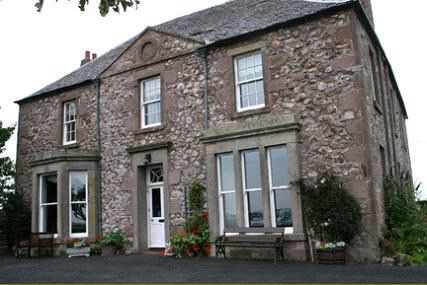
A disaster is not the most inviting topic and luckily in our family there are not that many disasters to choose from. One person in our tree that did have a disaster and I have chosen him as there is also a lot written about his adventures, is Peter Tait youngest son of Joshua Tait of Langrigg.
Peter Tait was born in Langrigg in around 1781, baptised 16 October 1781 at the local church in Whitsome and Hilton. Little else has been recorded about him till 1819, but between then and his baptism he got married to a local girl Agnes Hogarth, she was baptised in Edrom in 1779. I can find no marriage record, so evidence of their relationship is via their gravestone and their four children’s baptism (3 daughter and 1 son), which states the children were all legitimate.
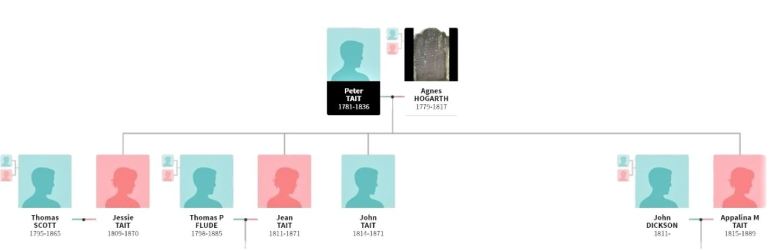
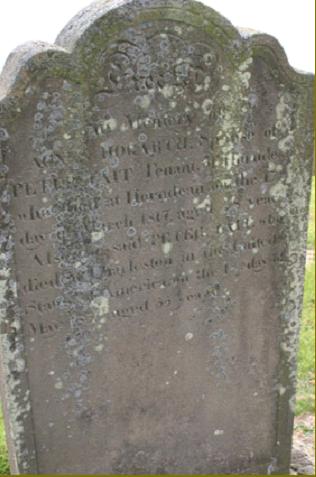
Sadly Agnes died in 1817, she is buried in the old kirkyard in Whitsome. Her gravestone reads “In memory of Agnes Hogarth spouse of Peter Tait tenant of Horndean who died at Horndean 13 March 1817 aged 38 years.” Their youngest child would have been only 3 years old. The inscription also says Peter was a farmer in Horndean.
We do not know what happened to the children after their mother’s death, I imagine they were put in to the care of family? The girls all married, but after their father’s death, the only son John lived and farmed the family estate of Langrigg, but his is another sad tale to be told later.
What Peter did next seems quite extraordinary, he decided to take a local group of people and migrate to the Cape of Good Hope in South Africa. He was one of the “pre 1820 settlers.”
In 1820 there was a Government sponsored scheme a “The Cape Emigration Scheme”. The scheme’s selection was to be limited to men who could afford to engage and maintain a party of at least 10 able-bodied labourers over the age of 18, with or without families. In return they would receive free passage and ‘victuals’ and be granted 100 acres of land in the Eastern Cape plus 100 acres per man in their party. Their initial aim was that the settler parties would be made up of middle to higher-class people who had some capital and would enter into agreements with members of their parties in exchange for land and a number of years working in the employ of the party leaders.
Peter’s story is told via letters sent by 2 of his brothers: Dr William Tait a navy physician (more about this brother in a future blog) & George Tait, also by Peter himself on his return from the Cape.
Dr William Tait & George Tait write a series of letters Mr Goulburn and others on Peter’s behalf, he seems to have arrived in the Cape on his own and is requesting help sending the rest of his party:
—————————————————————————————————————————————
Original Letter at National Archives, Kew CO48/46, 1
Somerset Coffee House, Strand
Tuesday January 5 1819
Dr TAIT presents his duty to Mr GOULBURN and begs most respectfully to acquaint him that he has received letters from his Brother at the Cape of Good Hope where he has received a Grant of Land in compliance with the official letter he carried out to His Excellency the Governor.
As Mr GOULBURN was kind enough to say, when Dr TAIT had the honour of an interview in February last, that he would see him again relative to the Settlers to be conveyed to the Cape whenever he obtained intelligence from his Brother of his having received the Grand of Land, he now, therefore, presumes on Mr GOULBURN’s kind condescension, and he will be infinitely obliged if Mr. GOULBURN will appoint a convenient time to see him, when he will state the objects he has in view and the assistance he expects from Government to enable his Brother to introduce a value System of Agricultural improvements and a very valuable & highly necessary class of Settlers into the Colony of the Cape.
[Note from GOULBURN across bottom of page] Appoint him for the next day I come to town]
Original Letter at National Archives, Kew CO48/46, 3
To P. SMITH Esq, Colonial Office
Southampton
February 18th 1819
Sir,
From your very kind attention to me in January last, I am induced to take the liberty of acquainting you, that I have this day written to Mr. GOULBURN on the subject of the Settlers I wish to send to the Cape of Good Hope, and if you will grant me an extension of your kindness by accelerating the application from your office to the Transport Board for their Passage, so that the Settlers may leave this Country as soon as possible, you will lay me under the greatest obligation.
I am aware that I have no claim or right to intrude upon you for favours of this sort, but being, like yourself a Public Servant (a Physician of the Royal Navy) I hope you will pardon my intrusion, and afford me all the assistance in your power.
I am Sir
Your most obedient & very Humble Servant
Wm TAIT
National Archives, Kew CO48/46, 5
Southampton
Febr. 18 1819
Sir,
I beg leave to take the liberty of acquainting you, that I have engaged Twenty Settlers in Scotland viz. seventeen men, and three women to go to the Colony of the Cape of Good Hope to be there located on the land granted to my Brother Mr. Peter TAIT.
They are ready and waiting my directions to proceed to London and if you will have the goodness to order a Passage to be found for them from London, by the Transport Department, so that they may sail from this Country in the first or second week of March next, it will be greatly beneficial to my Brother’s interest.
As I do not wish to order the Settlers to proceed to London till I know the precise period when the vessel which may be Chartered to convey them will sail for the Cape, I will be infinitely obliged to you Sir if you will give directions that I should have due information on that subject so that I may have fourteen days at the least to order them to sail from Scotland.
I am ready to Deposit the Sum required as a security [obscured] those Persons shall be located on the Land granted to my Brother and I will be much obliged if you will honor me with Instructions in that respect.
I have the Honor to be Sir,
Your most obedient & very Humble Servant,
Wm TAIT MD
[Note from GOULBURN across bottom of page] Request him to furnish a list of the persons of the members of the several families if any that passages may be ordered – 24 Feb
———————————————————————————————————————————–
National Archives, Kew CO48/46, 7
[from George TAIT, brother of William and Peter TAIT]
Langrigg, by Duns
March 4 1819
Sir,
I have the honor to prefix by my Brother Dr. William TAITT’s directions a list of the persons I have engaged in this Country to proceed to the Cape of Good Hope as Settlers to be located on the land granted to our Brother Mr. Peter TAITT and I take the liberty of informing you they are all ready to embark at Berwick for London whenever I am directed to forward them.
I have the honor to be Sir,
Your Most Obedient & very humble Servant
George TAITT
List of Names of Persons engaged to go out immediately to the Colony of the Cape of Good Hope to serve Mr. Peter TAITT there.
Plowmen & Women Servants
Isaac TAITT and his Wife 2 & four children
___ TAITT oldest son of Isaac TAITT 1
Henry AITCHISON 1
William WIGHTMAN 1
Isaac STEVENSON 1
Robert ROBSON 1
Andrew MARSHALL 1
Thomas HILL 1
James GRIEVE 1
Edward WAKE 1
John DOUGLASS 1
Jean OGILVIE 1
Joseph McDOUGAL 1
Peter LAIDLAW & his Wife 2 & 2 Children
Andrew PRINGLE – Blacksmith 1
George HAVERY Joiner 1
James DONALDSON 1
Total 19
[Note from GOULBURN]
Order a passage for them on deposit being made & acquaint him that this will be done
—————————————————————————————————————————————–
National Archives, Kew CO48/46, 9
Southampton
9th March 1819
Sir,
On being honoured with your letter of the 25th Ult., I wrote immediately to my Brother in Scotland, directing him to send you a list of the Persons he had engaged as Settlers to go to the Cape of Good Hope, and I have this day received a letter, acquainting me that he had sent you a list, consisting of sixteen men – three women – and six children.
When you have ordered the Tonnage to be provided for their conveyance, I will be much obliged if you will have the goodness to inform me, at what period the vessel will be engaged to sail from London, that I may have sufficient time to direct the Settlers to sail from Scotland to join her.
I have the honor to be Sir,
Your most obedient & very Humble Servant
Wm TAIT
[Note from GOULBURN] Let him know when we receive an answer
—————————————————————————————————————————————–
National Archives, Kew CO48/46, 11
Southampton
March 15th 1819
Sir,
I am honoured with your note of the 12th instant, and I beg leave to enclose, herewith, a Bill at sight, for one hundred and ninety Pounds, being the Deposit for the Settlers going to my Brother at the Cape of Good Hope.
In offering you my most respectful acknowledgements, for your very kind and handsome attention to me in this business.
I have the honor to be Sir,
Your most obed’t.& very Humble Servant,
Wm TAIT
[Note from GOULBURN]
Acknowledge receipt, book passages & write the necessary letter to Gov’r of the Cape
—————————————————————————————————————————————–
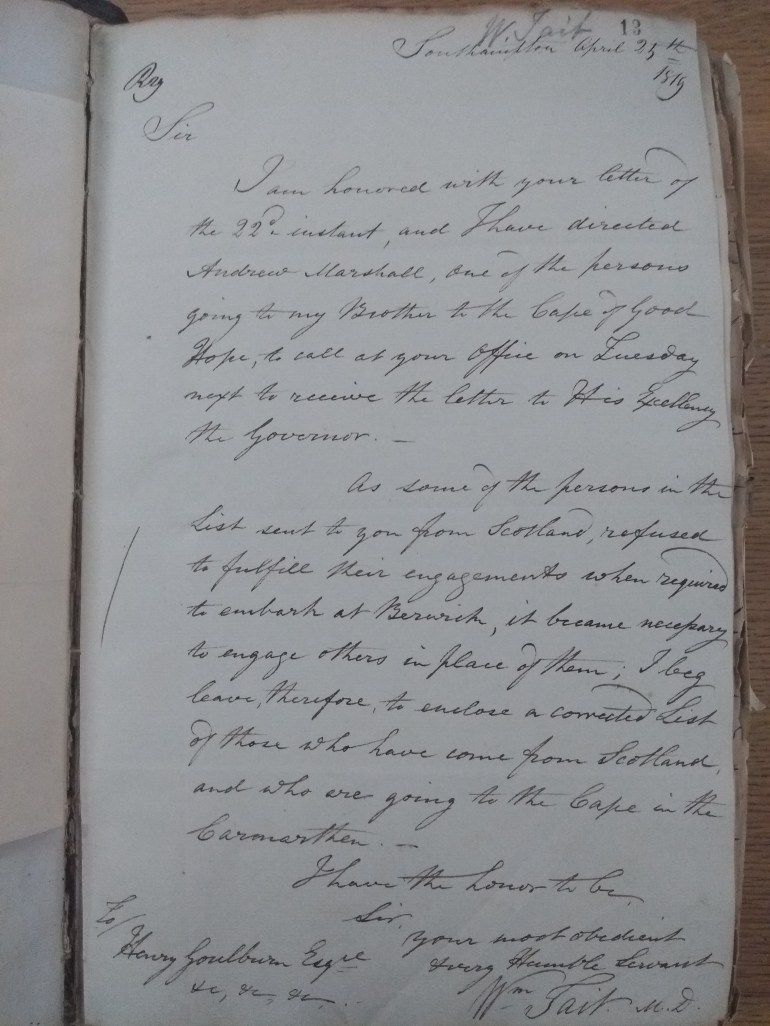
National Archives, Kew CO48/46, 13
Southampton
April 25th 1819
Sir,
I am honoured with your letter of the 22nd instant, and I have directed Andrew MARSHALL, one of the persons going to my Brother of the Cape of Good Hope, to call at your office on Tuesday next to receive the letter to His Excellency the Governor.
As some of the persons in the List sent to you from Scotland, refused to fulfil their engagements when required to embark at Berwick, it became necessary to engage others in place of them, I beg leave, therefore, to enclose a corrected List of those who have come from Scotland and who are going to the Cape in the Carmarthen.
I have the honor to be Sir,
Your most obedient & very Humble Servant,
Wm TAIT
A list of Persons going to the Cape of Good Hope to Mr. Peter TAIT in the Ship Carmarthen
Andrew MARSHALL 1
Henry AITCHISON 1
James STEVENSON 1
Robert ROBSON 1
Thomas HILL 1
James GRIEVE 1
Edward WAKE 1
John DOUGLASS 1
Joseph McDOUGAL 1
George HAVERY 1
James DONALDSON 1
James FOORD 1
Isaac TAIT & his wife 2 Children (under 12 years) 4
William FOORD aged 14 1
William FOORD & his wife 2
Children (under 12 years) 2
Margaret HAVERY 1
George OGILVIE 1
Total 25 Abstract 16 men – 3 women – 6 Children
April 25th 1819
Wm TAIT M.D.
—————————————————————————————————————————————–
We then go forward in time to 1824 and now have letters written by Peter Tait himself. He writes to explain why he returned to London and wrote to explain the disaster or “dreadful calamity” as Peter describes his experiences in the Cape.
National Archives, Kew, CO48/67, 321
London
Nov 17th 1824
Sir,
I have taken the liberty of calling at the Colonial Office on my return from the Cape of Good Hope. I had the honor of carrying out letters from Earl BATHURST to Lord C.H. SOMERSET, Governor of that Colony, in Feb’y 1818 (one year previous to the Albany settlers) By these letters I received every mark of attention from His Excellency and Col. BIRD, Colonial Secretary.
I located in the District of George twenty six settlers from Scotland and had that dreadful calamity the rust in wheat not infected that colony for three successive years I should have succeeded equal to my expectations; however, that famine has not made me alter my opinion respecting the capabilities of the colony in point of agriculture &c and I am a professional farmer in [Berwick?] Scotland from my first career in [obscured] and have been in Africa as a farmer five years.
Sir, my object in waiting at the Colonial Office is to express my [obscured] to Earl BATHURST and should any in[formation] be wanted respecting the colony of Cape of Good Hope I shall be most [obscured] to give His Lordship the same so far as I am enabled so to do.
I have the honor to remain Sir
Your most obedient humble servant
Peter TAIT
—————————————————————————————————————————————–
National Archives, Kew, CO48/67, 325
London
27 Dec 1824
Sir,
I shall feel much obliged by your doing me the favor of laying the statement enclosed herewith before the Earl BATHURST at your earliest convenience
I have the honor to be Sir
Your most obedient humble servant
Peter TAIT
{Transcriber’s Note: The enclosed statement below is not in Peter TAIT’s own hand]
My Lord,
In obedience to your Lordship’s wish expressed in the answer you did me the honor to return to my letter, I proceed to state such observations as occur to me respecting the agricultural state of the District in which I was located at the Cape of Good Hope, and as I have had opportunities at different times of visiting many other parts of the colony to add, with your Lordship’s permission, such observations as occurred to me on those occasions.
In the first place I have to inform your Lordship that I was located in the District of George, the Town bearing that name being situate about half way between Cape Town and Graham’s Town and on the east side of a flat but fertile country, extending about 24 miles in length and about 8 miles in breadth, called Outeniqualand, being the place of my immediate location.
The District of Outeniqualand was originally retained by the Dutch Government with [obscured] of being concocted into a Corn District and it was afterwards, by a Proclamation of Sir John CRADDOCK, granted out at [obscured] quit rents. This district can be converted to tillage at much less expense than most other districts of the Cape, and with proper attention and management is in an agricultural point of view capable of great improvement, besides possessing many local advantages such as having a superabundance of timber, the Knysna contiguous to the forest and Mossel Bay, where a Government store is erected capable of containing a great quantity of grain.
The Dutch Government, whilst the colony was under their protection, issued a notice to the Boers that they would take all the grain (wheat) that could be delivered at Mossel Bay. During the first year the notice was complied with, but during the second year, in consequence of an abundant harvest in the Cape districts, the Dutch Government withdrew from the engagement. In the mean time the store at Mossel Bay was filled with wheat & there it remained till it was totally useless; and scarcely at any future time has the district in question raised more grain than was necessary for the consumption and support of its inhabitants.
In 1819 notice was issued by the Burgher’s Senate to receive grain at Mossel Bay; but such notice being so near the approach of harvest, the Boers were not prepared to meet it, therefore a [small] quantity only was delivered. This notice was repeated the following year and as a consequence a very considerable [extra] quantity was sown; but during the [three] succeeding years that unfortunate calamity the rust swept all before it, not only in the district in question but in all the other districts of the colony, so much so as to create almost a famine – and I may be allowed to remark that His Excellency Lord C.H. SOMERSET was upon those distressing occasions & upon all others most kind & benevolent towards the inhabitants, and exerted his utmost & most anxious endeavours not only for their benefit but for the welfare and prosperity of the colony in general. The Corn Mills in the Colony (those in the vicinity of Cape Town excepted) are on the most miserable and inefficient scale, very few being capable of grinding more than one English quarter of wheat in the space of 13 hours. Now, as the District of George is well supplied with water for all purposes, I may be allowed to state it as my opinion that great benefit would result to the Colony at large were Flour Mills on a proper and efficient scale erected at convenient and proper places for the purpose of converting wheat into flour, instead of storing the former, as is the present custom, for in the first place by these means provisions would be made against any subsequent calamity arising from the rust – in the next place it would prevent the necessity of the Burgher’s Senate interfering with the Corn Trade, and by barrelling the flour it would keep a considerable time and be a great saving against the destruction of the wheat caused by the insect called the weevil – and with a market also established at George Town the Boers in the interior would be induced to bring their goods thither & return with timber, with which they can only be supplied from [this] district.
The Colony at present is at a great annual expence in the import of rice, and therefore were barley [mills] erected (there not being one in the colony) a great saving on that head [would in my opinion be the consequence.
It has been asserted by a late writer upon the Cape that the Colony is not capable of raising corn sufficient for the support of its present population and never can be lower than one hundred and fifty Rix dollars per ten muids. Now in my humble opinion this assertion is completely erroneous, and as a proof of it the crop of 1823 sold in March 1824 as low as eighty Rix dollars per ten muids and even corn was, to my knowledge, exported from the Colony, and that so soon after the distress occasioned by the three years failure of the crops.
The colony to the eastward of Swellendam is at present laying in a dormant and unproductive state from the want of a market at george Town – another advantage, therefore, would arise from the establishment of a market there, which is that the whole of that part of the colony would be brought into a state of productiveness & would even with its present population be capable of raising corn for exportation upon an average to the amount of forty thousand pounds sterling annually, and the Bays at the mouth of the Breed River and Mossel bay would afford every facility for exporting the same.
The Cape sheep are a breed of very unprofitable animals and ought in my opinion to be gradually extirpated and the Merino and South Down breeds substituted in their place – of the former there are [now] about 8,000 in the Colony and they thrive as well and attain a greater weight than the Cape sheep. The mutton also is preferred by the inhabitants. The South Down [breed] has been I believe but lately introduced into the Colony and I have no doubt in my own mind of their turning out well – I am therefore of the opinion that by encouraging & cultivating with due care the Merino and South Down breeds of sheep, and by gradually getting rid of the Cape breed, the advantage to the Colony would be very great; and were there in the Colony at this period the same number of Merino and South Down sheep as there is Cape sheep, the quantity of wool by a moderate calculation would produce (allowing for one fourth of the present price to be diminished by the extra quantity brought to market) the sum of one hundred and eighteen thousand one hundred & twenty five pounds sterling annually.
In consequence of the dreadful distress occasioned by the three years failure of the crops, sheep can rarely be purchased for slaughtering above two years old, whereas about six years since they could be purchased for the same purpose four years old & upwards. Now were the number of Merino & South Down sheep increased so as to avoid the necessity of killing them under 4 years old, the quantity of wool would of course be also increased to the amount or value of nearly seventy eight thousand seven hundred & fifty pounds sterling yearly.
In the Cape [Calendar?] of 1824 an account is given by Mr. VAN BREDA of the management of his flock and he then states that by [putting] Merino rams to a herd of Cape ewes that those of the latter more nearly approached [obscured] wool. It is well understood by [practical?] men that by crossing the breed of sheep [& black?] cattle the crossed can never be depended upon and will revert back to their original breed, therefore should that system be carried into effect it certainly will defeat the purpose that is so earnestly wished for as a very few fleeces of inferior wool can render a whole pack of pure genuine [wool] totally useless to the manufacturer, and ultimately the Cape wool would not find a market.
The Boers state one objection to the growth of wool in the Cape, viz the want of proper places for washing it. Now in my opinion that objection might be removed by constructing proper reservoirs in the districts where there are no streams of water.
The breed of Black Cattle in the colony is by no means deficient for agricultural purposes, tho’ the cows I admit are very deficient for the purposes of the dairy. I am of opinion that beef never can be cured to any extent as the artificial grasses will not thrive in the colony in consequence of the severe droughts with which it is frequently visited, therefore the cattle are not sufficiently fed to admit of the beef being salted, so as to prevent it from becoming dry & hard.
The Cape horses are very small and very ill adapted to the purposes of the Colony. His Excellency Lord Charles SOMERSET introduced the English breed of horses at the Cape and the immediate districts, and which in a short period has improved beyond all calculation – as a proof of which, in Cape Town two horses perform the same work that required six formerly. In the interior districts a breed of strong English agricultural horses would be of great benefit to the country, as it would be the means of rendering a smaller number of labourers necessary.
The roads in the Colony require attention. The road which is now nearly finished at the French hoek will be a great facility, by avoiding the mountain of that name, and making an easy conveyance over that part of the country. It would in my opinion be a great improvement to the Colony were the roads properly surveyed from Cape Town to the districts on the frontiers, more particularly to Graham’s Town, with a view of forming roads to lead from the public line of road to the Bays and interior districts. The expence would be trifling and the roads would neither require forming materials, the line or direction being all that would be necessary, except where passes and mountains occur. From the extraordinary height the rivers attain in cases of flood, bridges are by no means adviseable. Ferry boats are in my opinion much more preferable. At present it is a very great burden, and frequently a matter of complaint on the part of the Boers who are situated near the public roads, by being obliged to accommodate the nervous travellers passing from Cape Town to Graham’s Town. It is also very unpleasant for the traveller to be obliged to force himself upon the Boer’s residence and hospitality. I would therefore suggest that instead of outspan places reserved by Government for grazing the cattle of travellers, houses and proper buildings should be erected at convenient distances on the roads with a sufficient quantity of land to each for the accommodation of travellers & others, allowing the occupiers of such houses the Government allowance in forwarding the post and the privilege of the spirit licence; and this in many instances would be a good living for discharged veterans.
The Cape wine is of low estimate in England – the Constantia vine having such a superiority over the other vines in that Colony led my curiosity to minutely examine both CLOETE’s & COLYNE’s vineyards, and I found both to be of the same soil, namely a decomposed granite, the adjoining soil being a rich red loam. The wine from Drakenstein and the Pearl are the next in estimation. I was not in Drakenstein, bur examined the vineyards at the Pearl and found the higher part of them composed of a similar soil to CLOETE’s and COLYNE’s.
The general system of the vine growers at the Cape is to make choice of low swampy situations as being more sheltered from the south east winds. Those situations certainly produce wine in much greater quantity, but never will produce it of good quality; and were experiments made in higher & more appropriate situations I have no doubt that the Cape wines would cope with those of other countries.
I may remark of the Colony generally that it has the superiority over many others from its climate, and none can raise grain with so little labour and expence, but the want of labourers for reaping and machines for threshing the corn are much felt, as are also, as I have before remarked, the want of markets and the consequent fluctuation of prices occasioned by the interference of the Burgher’s Senate. It is also necessary to observe that farming at the Cape, in all its branches, is very different from that in England; and that the most experienced English farmer, both in practice and theory, would require to be two years resident in the Colony before he could be aware of the real nature of the soil and climate, the dangers his stock is liable to, and other difficulties which experience alone could teach him.
It may be said that the Colony in an agricultural point of view is at present in a torpid state and will not be easily roused or brought into action without the aid of the British Government, and owing to the unfavourable (but in my opinion unfounded) reports circulated by the disappointed and inexperienced settlers, but few British farmers would be induced to embark their capital in the Colony, and the failure of three years crops, coupled with other circumstances, has impressed upon the minds of the ignorant and illiterate Boers that their forefathers’ system of management is the only one to be pursued & that they should by no means deviate from it in future.
I may be allowed to add that after the first two years failure of crops by the rust I was induced to try, at considerable expence to myself, no less than six different experiments with the seed wheat sown for the third year’s crop, in the hope of preventing a third years failure from the same calamity, but I am sorry to say to no purpose.
From experience and local knowledge I am of the opinion that were the capabilities of the Colony fairly and judiciously brought into action it would not only in a few years be in a situation to support itself with little or no expence to the British Government, but would become of importance as a British Settlement in may other productions such as (such as sea silk &c &c) which never have been nor never will be [introduced] unless by the British Government.
My Lord I trust I may be pardoned in the liberty of stating to your Lordship anything in reference to [myself] individually but in consequence of three successive years of rust not only my means became exhausted but my future prospects there completely ruined and those unfortunate but unavoidable causes alone induced me to return to England after a residence of nearly seven years in the Colony.
Thus circumstanced, my Lord, might I be allowed humbly to solicit your Lordship’s favour and interference in my behalf by conferring upon me any situation or appointment at the Cape which your Lordship might be pleased to consider my local knowledge & experience and humble abilities adequate to. This, my Lord, circumstanced as I am at present, would be a favour indeed, and one that should command my most sincere and grateful acknowledgement.
I have the honor to be most respectfully, my Lord,
Your Lordship’s obed’t humble servant
Peter TAIT
—————————————————————————————————————————————–
I have not found any more information about of Peter’s life, so sadly the final record is his death and this recorded on his wife’s headstone in old kirkyard in Whitsome (see image a top of blog).
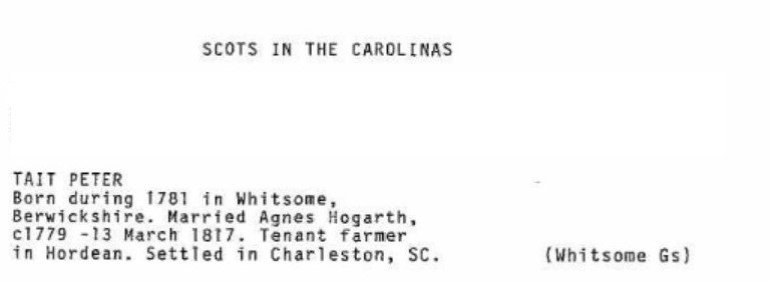
He died on 18th May 1836, some 12 years after his return from the Cape. He was living and assume buried in Charleston, South Carolina, USA.
What he did was doing in Charleston I haven not yet discovered, but hope to one day learn more about his last adventure!
—————————————————————————————————————————————-
So you may be wondering how I discovered the story of Peter’s attempt at farming in the Cape of Good Hope? by pure chance and some “Googling” I came across a website “The 1820 Settler Correspondence, as preserved in the National Archives, Kew and edited by Sue Mackay” Sue has kindly given me permission to share her amazing work.
https://www.eggsa.org/1820-settlers/index.php.
The website introduction:
The Correspondence in connection with the 1820 Cape Settler Scheme is preserved at the UK National Archives at Kew and contained in class CO48. Each file is in fact a large leather bound volume into which the correspondence has been inserted (this is the cause of so many [obscured] words as they disappear into the binding, and of course one is not allowed to undo them). The letters were bound in the 19th century, and were filed in order of receipt…
I recently visited the National Archives and was able to read the original letters:
 not just any family