

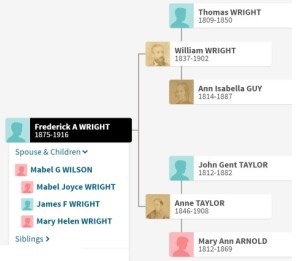
Fred was born on 22 Oct 1875 in 2 Station Road, Balham, Surrey. His parents were William Wright and Anne Taylor. He lived in the family home, with his parents and siblings at 9 Blackmoor Street, near Drury Lane in the parish of St Clement Danes London. This is where his grandparents began their cheesemonger business around 1830 and his father continued the business after his grandfather’s death.
Fred was baptised in December 1875 at the Great Queen Street Chapel in Camden, this was a Wesleyan Chapel that was demolished in around 1910.
Sometime after his sister Isabella was born in 1882 but before the youngest, Anne (my great grandmother was born) in 1883, the family moved to 8 Ferm Park Road in Hornsey. This was before the development of the St Clement Danes area as part of the creation of the Aldwych and Kingsway.
By the 1891 census, Fred is 16 and working as a cheesemonger, alongside his parents and older siblings. According to the 1901 census, Fred and 5 of his siblings are still living at 8 Ferm Park Road running their cheesemongers. Their parents, William & Anne had moved to St. Clement Danes Almshouses in Garratt Lane, South London. The almshouse was an early type of retirement accommodation.
In 1909, Fred married Mabel Gertrude Wilson, who lived on Broadway in Crouch End, which is close to where Fred lived and worked, perhaps she was a customer?
Fred and Mabel moved in with her parents after their marriage and in the 1911 census they are still living there, with their first daughter Mabel Joyce (born 24 June 1910), who is nine months old. Fred is now described as a “cashier working for a Wholesale Previsioners”.
Fred and Mabel moved to 7, Elms Avenue, Muswell Hill, where they had two further children; as son named James Frederick born 31 October 1911 and a daughter Mary Helen born 10 May 1915.
On 28 March 1910, Fred was a Cashier & Accountant when he was initiated into the United Grand Lodge of England Freemasons in the Henry Levander Lodge in Harrow.
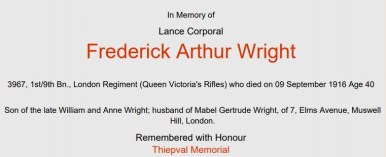
Fred enlisted in the army shortly after the start of World War 1. He became a Lance Corporal in The London Regiment (Queen Victoria’s Rifles), 1st/9th Battalion. Service No: 3967. (no service record found).
Sadly Fred was killed on 9th September, whilst serving his country in France. He was killed during the Battle of Ginchy.
The Battle of Ginchy took place during the Battle of the Somme, when the 16th (Irish) Division captured the German-held village. British attacks northwards from the boundary between the Fourth Army and the French Sixth Army, from Leuze Wood north to Ginchy, had begun on 3 September when the 7th Division captured the village, before being forced out by a German counter-attack. Attacks on Leuze Wood and attempts to re-take Ginchy on 4 and 5 September were also defeated by German counter-attacks.
On 9 September the British began a bombardment early in the morning but waited until late afternoon to advance, to deny the Germans time to counter-attack before dark. The British assault in the south by the 56th (1/1st London) Division and the 16th (Irish) Division reached Bouleaux Wood but the attack in the centre was repulsed. On the northern flank, Ginchy was captured by the 16th (Irish) Division and several German counter-attacks were defeated. The loss of Ginchy deprived the Germans of observation posts from which they could observe the battlefield. The success of the attack by the French Sixth Army on 12 September, in its biggest operation of the battle and the advance of the right flank of the British Fourth Army from 3 to 9 September, enabled both armies to make much bigger attacks. The assaults were sequenced with attacks by the Tenth and Reserve armies in September, which captured much more ground and inflicted approximately 130,000 casualties on the German defenders. Anglo-French attempts to co-ordinate their attacks had failed from July to early September, due to a combination of disagreements between Haig, Joffre and Foch over tactics, supply difficulties, devastated terrain, inclement weather and the increasing defensive power of the German armies. In September, the Allies managed to co-ordinate their attacks; advances on each army front made adjacent German positions vulnerable, which were attacked promptly by the neighbouring army before the Germans recovered from their disorganisation. Ginchy was at the centre of battle and suffered severe damage as a result.
Fred has no grave as his body has not been found, but he his remembered on Thiepval Memorial to the Missing of the Somme, France.
Here are recorded
names of officers
and men of the
British Armies who fell
on the Somme battlefields
July 1915 February 1918
but to whom
the fortune of war
denied the known
and honoured burial
given to their
comrades in death.
Fred was posthumously awarded: The Victory Medal, The British Medal and The 15 Star medal.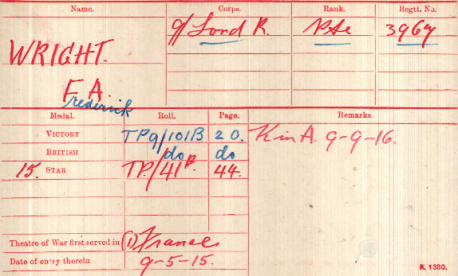
R.I.P. great great Uncle Fred
 not just any family