
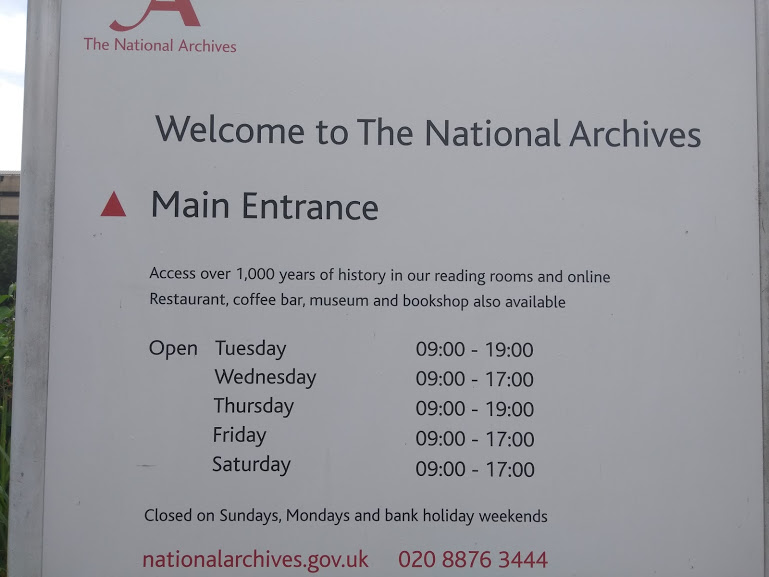
It is around 8 years since I visited the National Archives in Kew, and a few months ago I saw post on their Twitter feed @thenationalarchives, promoting their “Behind the Scenes”, and thought “an interesting summer holidays outing?” and booked, paying my £10 fee.
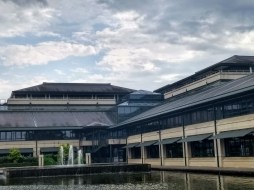
I set off early one Friday morning to Kew Station. Then walked the shortish distance to The National Archives (TNA).
Inside the building is not very well signposted inside and had to ask where you go to renew readers card. The process was quite quick and still had some time to spare before tour due to start, so looked round an exhibition “Britain’s Cold War Revealed”.
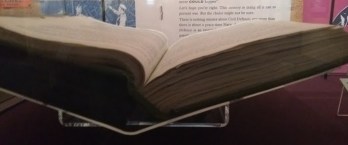
The exhibition was really interesting , well set out and informative. The best bit (for me) was a copy of The Strath Report, which was produced by William Strath and his committee on, “The Deference Implications of Fall-Out from a Hydrogen Bomb”, in 1955. It sets out how Britain could prepare for an H-bomb attack, including evacuation plans and stock pilling of food and water. Sir William Strath or uncle Bill was my great uncle, he was married to my paternal grandfather’s sister, so my great uncle! Although I have seen the report on line to see a real original copy was so nice.
At 11am, a small group of us gathered in the main reception hall; 12 visitors and two members of staff> We had to deposit all of our possessions in a locker, just allowed to carry our phones or cameras. After receiving our temporary identification lanyards, introductions were made and a brief history of how and why The National Archives were started, all because of a pesky dead rat!
“Between 2003 and 2006, four government bodies – each specialising in particular aspects of managing information – joined together to form a single organisation in The National Archives
* the Public Record Office, created as a result of the Public Record Office Act 1838 – the national archive of England, Wales and the United Kingdom government, dedicated to preserving key public records and making them accessible to researchers
* the Royal Commission on Historical Manuscripts, appointed under Royal Warrant in 1869, performs the Historical Manuscripts Commission’s functions in relation to private records
* Her Majesty’s Stationery Office, founded in 1786, holder of Crown copyright and official printer of all Acts of Parliament since 1889
* the Office of Public Sector Information, created in 2005 following a European Union directive to promote the re-use of information produced and collected by public sector organisations” extract from from http://www.nationalarchives.gov.uk/about/our-role/what-we-do/our-history/
The 1st building (Kew 1) was created 40 years ago and the way and newer Kew 2 (built 20 years ago). The floor mosaic tile pattern was designed by an artist and incorporate some of the slate from the original archive shelving.
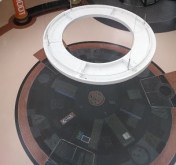
There is an a transition area in Kew 2, where there are several examples of archive chests that were for keeping documents safe with different locking mechanisms, these are beautiful examples of really old archival services.
We then went further into the Kew 2 building and looked at some of the storage facilities that documents how they kept the gentleman also told us about how they used to let things to go into the archives.
He also demonstrated to the retrieval system so what happens when you request a document how it is taken down from the shelves where it is stored and ends up in your box as a reader and so you can take it to your desk. They have a series of different type of retrieval mechanics small boxes are easy but obviously the bigger ones become more of a health and safety risk to the staff they have various stands with changing heights lifts etc. and a great deal of attention is given to looking after the staff and the documents during the retrieval process.
We were also shown an ice cream cabinet which was bought to store old film that is at risk of combustion all the film has been digitised, they’re not allowed to destroy the film but need to keep it stable.


Towards the end of the tour they had a room set aside with some examples of documents of various sorts to show us and he gave us a brief talk about each item explaining where they come from why it was there what it may be used for.


As we were leaving, we were presented with a little party bag with some items in to take home: postcards, a pencil and a key-ring.
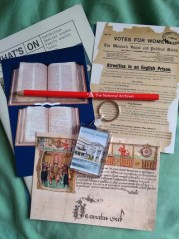
The tour was really interesting the staff care so much about looking after the archives and helping the readers who can use the material. when you consider we got free gifts probably almost to the value of the £10 ticket it was a really good value for money thoroughly enjoyable to ours would recommend to anybody interested in archives genealogy and family history or history of any sort.
After some lunch, I went back into archives to find and read the documents I had pre- ordered.
 not just any family
Sounds a nice visit. It is common sense to bring together four different government offices, though the building designs were likely old by the time they did that, as I know from my time working for another government department!
LikeLike