
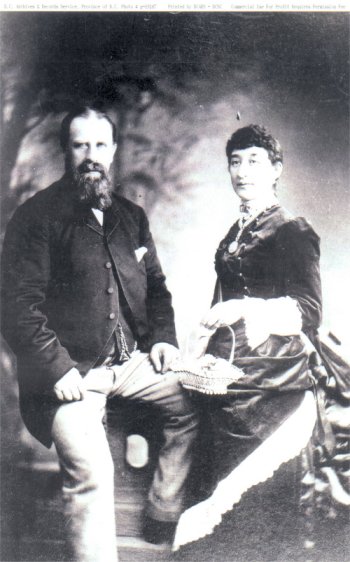
I found this story on the Ancestry website which tells William’s story better than I ever could….
William Pinchbeck was born in Yorkshire [sic; Lincolnshire], England, in 1831. In 1849, he and his two brothers. Michael and Anderson, emigrated to California and the lure of the goldrush.
The reason for the three setting their sights on the goldfields of Calilornia is unclear. There’s little doubt the three had a thirst for adventure but it’s quite possible they were also reacting to social changes in England. At that time, the landed gentry were kicking many of their less fortunate brethren off the land as they built massive estates. Under such conditions the young William Pinchbeck may have left England with one valuable lesson tucked under his cap – ownership of land meant power
In California, the three brothers kept busy with mining and operating a hotel. In the 1850s the three brothers parted company – William heading north to the goldfields of the B C Interior while his brothers went to Australia and Patagonia (the southern third of what is now Argentina).
Three brothers. three different continents. One can only guess that the three, still enfused with the sense of adventure, made a wager over would become the most wealthy in their new homelands. If such was the case, Michael and Anderson would have found great riches to eclipse what William was on the verge of discovering in the Cariboo. It’s not known what the future did hold for Michael and Anderson.
In 1859, William and a friend from California – William Lyne – left Victoria for the Cariboo Goldfields. The adrenaline rush of adventure was to be found in many young men arriving in the Cariboo during that period, but what set the likes of Pinchbeck, Lyne, Robert Borland, Sam Yorston, Sam Simrock, Tom Paxton and Charles Eagle apart was that the wealth they saw glistening in the Cariboo was in the availability of farm and ranch land.
After arriving in 1860 and taking preemptions on land in tile Williams Lake valley, Pinchbeck and Lyne formed a partnership to farm and ranch the properties. The produce, wheat and meat being sold to feed the hungry goldminers in their usually vain pursuit of striking it rich. Between 1860 and 1863, it appears Pinchbeck and Lyne purchased buildings and property from the oldest settler in the valley – Thomas Davidson – including a stopping house. The property, located in the Glendale area, became known as Upper House.
An advertisement in the Victoria Colonist of 1863 beat the drum of Pinchbeck’s Hotel and Store as:
accommodation for travellers unsurpassed by any hotel in the country. The table is constantly supplied with every delicacy that money can purchase. A large stock of miner’s supplies of every description constantly on hand. The choicest brands of wines, liquors and cigars to be held at the bar.
Upper House also soon likely held a rudimentary gaol. During these early years Pinchbeck had been named a constable by gold commissioner Phillip Nind. It was Pinchbeck’s job to capture the accused and hold them for trial until Judge Begbie, making his circuit through the Interior, dispensed with the cases. Pinchbeck would later be appointed a justice of the Peace. Between 1863 and 1866 Pinchbeck took a wife though it’s not known if it was a legal marriage. His wife, Chulminick, was the daughter of Chief Willy’um, the second of three Shuswap chiefs to bear that name. It is believed Williams Lake is named after the first. Chulminick bore two sons, William Jr. in 1867 and James. There is no record of daughters being born but that doesn’t necessarily mean there weren’t any female offspring.
Through the remainder of the ’60s and ’70s, the Pinchbeck and Lyne partnership prospered. It showed in their relentless pursuit of land and the development of Lower House – where the Stampede Grounds now stand. The partners corralled most of the property in the valley. On that property they grew vegetables, grain, hogs and cattle, The stopping house was soon joined by a brewery and distillery that produced a renowned spirit called White Wheat Whiskey. They also added a grist mill to grind the grain powered by water diverted from Mission Creek.
In the fall of 1883, Pinchbeck journeyed back to England. He returned in the spring of 1884 with farm and sawmill equipment, his sister Helen [sic; Mary Hannah], and a young wife – Alice Elizabeth. What had happened to Chulminick is unclear. It was not an uncommon practice for settlers to take a native wife and once they had prospered, send her back to her band so they could marry a white woman. It is also possible that she succumbed to one of the white man’s diseases, particularly small pox that decimated the interior natives during this period – sometimes with the apparent blessing of the colonial and later provincial government in Victoria and New Westminster. Nevertheless, William Pinchbeck appears to have remained devoted to his two sons, William and James. A booklet produced for the 1989 Pinchbeck Reunion recounts a story of William Jr , who ran a pack train for his father to Omineca, was deputized by his father to bring in a suspected murderer who lived in a cabin on the pack trail. He found the man in a cellar under the cabin floor. A shot rang out narrowly missing him. William Jr. lept into the cellar and overpowered the villain, bringing the man to justice. With Alice Elizabeth – there is no record of her maiden name though the wedding had taken place in Hull, England, – William had three more sons, Cyril, Robert and Frederick.
There was also a daughter, Emma [sic; William’s niece – Anderson’s daughter].
In 1887, with all of Williams Lake at the partnership’s command, the 28-year partnership and a friendship that dated back to the days of the California goldrush, began to unravel. The reason remains a mistery.
The visit of Messrs. Pinchheck and Lyne, joint owners of the Williams Lake farm, Cariboo District, to Victoria, was for the purpose of dissolving the partnership. Mr. Pinchbeck purchased his partner’s interest. It is not known how much money changed hands in the transaction, but it must have heen considerable, for the property is one of the finest ranches in B.C., five hundred acres being in wheat alone some years. The farm is:supplied with the latest improved agricultural machinery, including a steam thresher, and has on its broad acres a large flouring mill and sawmill. It is one of the most important suppliers of Barkerville and other points in the Cariboo, and is managed on a scale which is generally a surprise to strangers. Mr. Pinchbeck has recently completed a handsome residence facing the lake, and commanding a magnificent prospect. It is his intention to continue the extensive cultivation of the ranch. Mr. Lyne will probably embark in trading on Quesnelle-mouth. Both gentlemen are pioneers of the country, Mr. Pinchheck having been in the Imperial Service (policeman) in the early days of the Cariboo gold mining. They returned by this morning’s steamer to the Mainland.
Lyne moved 13 miles north to Deep Creek where he started a stopping house, became a blacksmith and built a lumber mill. He later moved to Ashcroft where he managed a hotel until his death in 1906. William Pinchbeck now commanded everything he had seen in 1860 when he arrived in the valley seeking fame and fortune. His power and influence extended throughout the Cariboo, wherever pack trains moved his supplies.
He sought a seat in the provncial legislature in 1890 but his bid failed. That may well have been the first time he failed to succeed at something; he seriously had put his head toward achieving. In 1892 his health began to fail. He made a trip to Victoria and underwent surgery in early 1893.
On July 30, 1893 he died in 150 Mile House at the age of 62.
His wife Alice sold off the assets, much of the valley landing in the hands of Robert Borland. Alice apparently moved to Victoria with the four children. She later remarried a man call Joseph Ratchford and moved with the family to Kamloops where they ran an old folks’ home.
 not just any family